Galaxy Morphology
Undergraduate Research at the University of Missouri
My first research experience, circa 2019
Background
Understanding the formation and evolution of young galaxies in the early universe is a pivotal goal in cosmology. These galaxies reveal clues on how large galaxies, like our own Milky Way, were formed and evolved. In this project, we used data from the Cosmic Assembly Near-infrared Deep Extragalactic Legacy Survey (CANDELS)to study the physical properties of distant extremely young galaxies. CANDELS, one of the largest programs of the Hubble Space Telescope, imaged over 250,000 distant galaxies in multiple wavelengths in optical and near-infrared.
Methods
To search for extremely young galaxies from this huge dataset, we use a criterion to select galaxies whose brightness in a certain near-infrared bandpass is dramatically boosted by the emission from the interstellar medium in star-forming regions.
Results
After reducing noise and uncertainties in our sample, we selected 311 candidates. Their stellar masses range around 10–100 million times the mass of our sun, making them 100–1000 times smaller than our Milky Way.
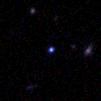
An RGB of one of our selected candidates.
- Categories:
- Undergraduate Research
- See Also: